Australia’s Pleistocene ecosystems included a predator so unusual that early scientists struggled to interpret its fossils. Thylacoleo carnifex, commonly called the marsupial lion, was not a cat at all. It belonged to the marsupial branch that also includes wombats and koalas, yet its skull, teeth, limbs, and claws became specialized for a meat-eating lifestyle unlike that of any living Australian mammal.
Calling it Australia’s “deadliest predator” would go beyond the evidence because fossils cannot provide a simple danger ranking. What researchers can say is that Thylacoleo was a formidable large carnivore and scavenger with exceptionally specialized cutting teeth and powerful forelimbs. Some features invite comparisons with big cats, especially an ambush-style interpretation, but its anatomy evolved along a completely different marsupial path.
Marsupial, Not Cat

The nickname “marsupial lion” describes ecological resemblance, not close relationship. Queensland Museum notes that Thylacoleo was related to koalas and wombats, while Australian Museum places it within the extinct family Thylacoleonidae. Its ancestors came from a marsupial lineage very different from the placental carnivores that produced lions and tigers. Evolution nevertheless pushed this animal toward a large predatory role. The result is a striking case of separate mammal groups arriving at some similar hunting functions while retaining very different skulls, teeth, feet, and reproductive biology.
Large Predator

Thylacoleo carnifex was the largest known member of its family and reached a body size comparable with a large modern big cat. Estimates vary among specimens and methods, so any single weight should be treated as approximate rather than exact. Its heavy build suggests an animal designed more for power than prolonged high-speed pursuit. Fossils occur across much of Australia, indicating that this predator was not restricted to one tiny refuge. It occupied Pleistocene landscapes alongside giant kangaroos, diprotodontids, large reptiles, and other now-extinct animals.
Shearing Teeth

The marsupial lion’s teeth were among its strangest adaptations. Instead of the large canine teeth seen in cats, it had enlarged incisors at the front and huge blade-like premolars that acted as cutting surfaces. Queensland Museum describes these teeth as suited to piercing flesh, slicing meat, and even cracking bone. That arrangement initially confused nineteenth-century anatomists because the animal belonged to a broader marsupial group dominated by plant eaters. Eventually, the lack of grinding teeth and the cutting specialization helped establish that Thylacoleo was genuinely carnivorous.
Powerful Bite
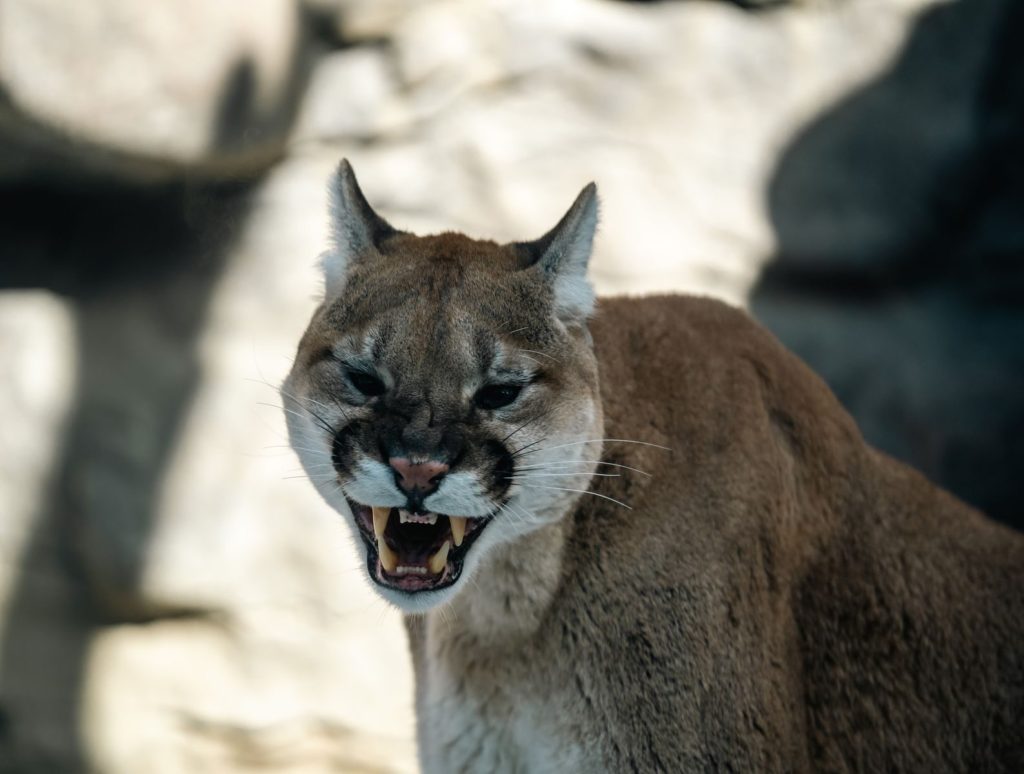
Biomechanical research has portrayed Thylacoleo as an unusually powerful biter for its body size. A short, deep skull created room for substantial jaw muscles, while the enlarged cutting teeth concentrated force during feeding. That combination would have been useful for quickly damaging flesh after prey was seized. Exact comparisons with living carnivores depend on modeling assumptions, so claims that it had the single strongest bite of any mammal should be treated cautiously. The broader conclusion is secure: its skull was built for forceful, highly specialized meat processing rather than chewing vegetation.
Grasping Forelimbs

The forelimbs of Thylacoleo add to the impression of an ambush predator. Fossils show robust arms and a large claw associated with the first digit, giving the animal an effective gripping apparatus. A predator that could hold struggling prey with powerful forelimbs would not need to rely on catlike canine teeth in exactly the same way. Researchers have proposed that the claws and limb strength helped seize or immobilize large animals. These reconstructions are based on anatomy, not direct observation, so the details of every hunting sequence remain inferential.
Climbing Ability

Foot anatomy indicates that Thylacoleo was capable of climbing, although scientists continue debating how often an animal of its size used trees. Curved toes, grasping features, and retractable claws would have helped it hold uneven surfaces as well as prey. Tree climbing could have provided refuge, access to elevated resting places, or assistance handling carcasses, but comparisons with modern leopards should not be pushed too far. The evidence supports climbing ability more strongly than any specific claim that marsupial lions routinely hauled large kills into branches.
Megafauna Prey

Australia’s Pleistocene fauna gave Thylacoleo access to an extraordinary range of possible prey and carrion. Australian Museum material notes evidence linking the predator with large herbivorous megafauna, while fossil injuries and tooth marks help researchers investigate feeding relationships. It may have attacked kangaroos and other substantial mammals, but individual fossil marks cannot reveal the full diet by themselves. Like many large carnivores, Thylacoleo may also have scavenged when opportunities appeared. Calling it strictly a hunter or strictly a scavenger would create a false choice.
Extinction

The marsupial lion disappeared during the broader late Pleistocene loss of Australian megafauna, surviving until roughly tens of thousands of years ago. Queensland Museum places the youngest part of its known range around 40,000 years ago. Researchers continue debating the relative roles of climate change, ecological disruption, and human impacts in Australia’s megafaunal extinctions. Whatever the exact combination, no living predator occupies precisely the same anatomical niche today. Fossils are therefore the only evidence for an Australian carnivore that evolved a remarkably cat-like role without ever becoming a cat.
Featured Image: Photo by Emilio Sánchez Hernández on Pexels