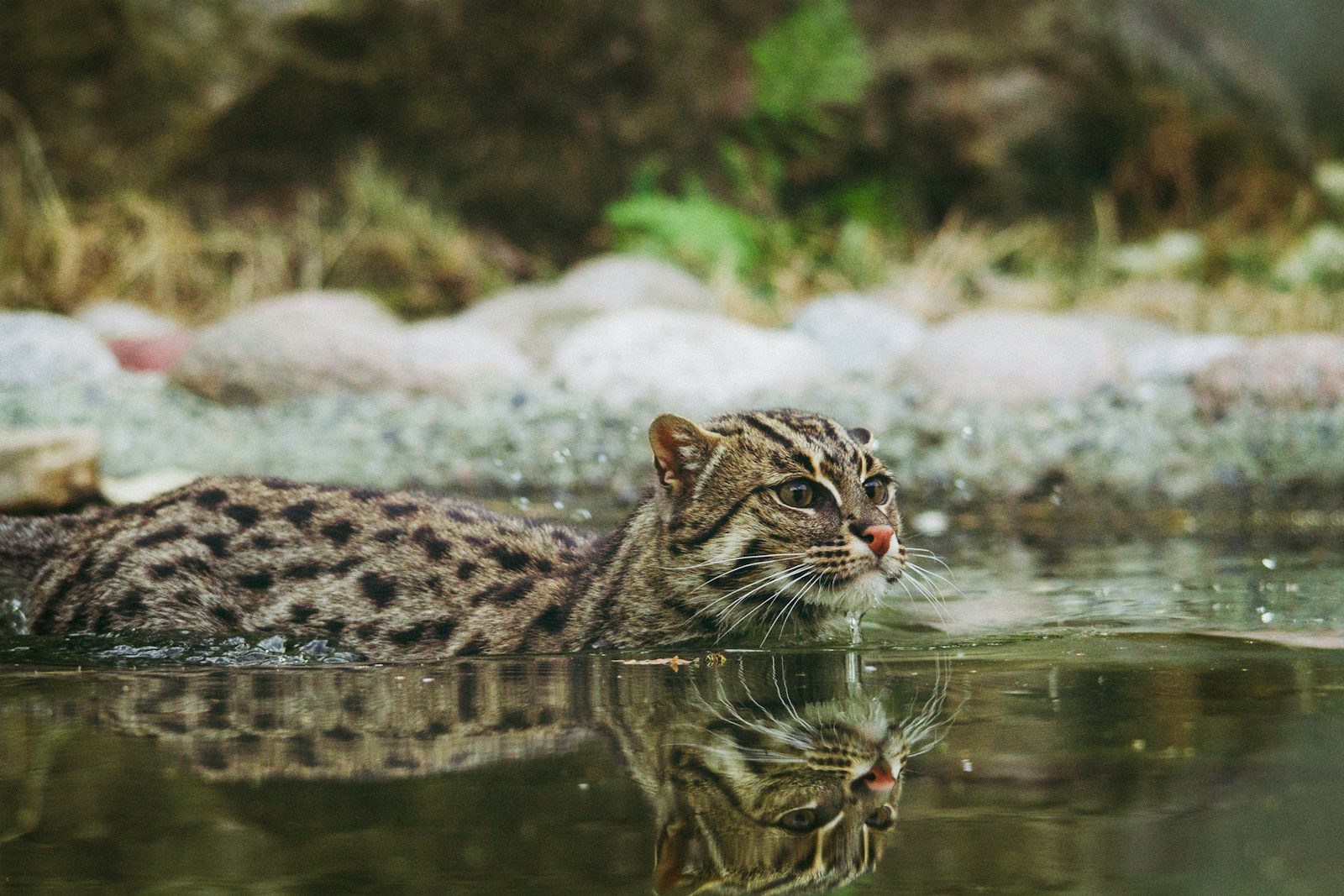
The closest well-documented match for this premise involves fishing cat kittens at the Smithsonian’s National Zoo. In 2012, keepers reported that young kittens watched their mother, Electra, fish before the family later began exploring and fishing together on exhibit.
The evidence does not prove a dramatic instant in which kittens with no hunting experience suddenly became experts. What it does show is more interesting: young fishing cats begin practicing behaviors that fit a species naturally adapted to wetlands and aquatic prey.
Fishing Cat Kittens

Fishing cats are medium-sized wild felids native to parts of South and Southeast Asia. The Smithsonian’s National Zoo successfully bred two kittens in 2012, the first successful fishing cat birth at that institution. Their mother was a female named Electra, an experienced adult the kittens could observe.
By late June, keepers reported that the kittens were active and spent much of their time playing and watching Electra fish. When they went on public exhibit at about three months old, the zoo described them exploring, climbing, playing, and fishing. Those observations provide a verified version of the viral-style story.
Watching Their Mother

Young predators are not born with polished adult hunting technique. They develop coordination through play, exploration, repeated attempts, and experience with prey and habitat. At the National Zoo, the kittens had a direct model in Electra, who regularly fished while they watched from the enclosure.
A later Smithsonian update about another kitten, Wasabi, described the youngster watching Electra and then trying fishing with enthusiasm. That does not prove simple imitation caused the behavior, because hunting also has innate components. It does show that young fishing cats practice around an experienced mother while their skills develop.
Wetland Wildcats

Fishing cats are strongly associated with wetlands, including marshes, swamps, mangroves, rivers, and streams. Unlike the stereotype that cats avoid water, this species regularly enters shallow water and is capable of swimming. Aquatic prey forms an important part of its natural feeding ecology.
The name is therefore unusually literal. Fishing cats do not merely grab an occasional stranded fish; researchers have documented specialized strategies for locating and capturing prey in water. Their habitat, body form, and behavior all reflect a semi-aquatic lifestyle that separates them from many better-known small wildcats.
Shallow-Water Hunting

A 2022 study analyzed 197 camera-trap video clips to describe how wild fishing cats capture aquatic prey. In shallow water, the cats used a predominantly active strategy, moving through the water and attempting to flush fish rather than simply waiting motionless on the bank.
Researchers found that about 96 percent of shallow-water hunting behavior was active. That makes a kitten splashing, pawing, and pouncing at fish more than random play: those movements resemble behaviors adults use during real hunts. Young animals still need practice before they can perform them efficiently.
Deep-Water Patience

Fishing cats change tactics when the water gets deeper. In the same field study, the animals spent about 52 percent of observed time sitting and waiting for fish to approach, while actual hunting attempts in deeper water were comparatively limited.
When they did make deep-water attempts, the researchers recorded a success rate of about 42.86 percent, although that figure came from a limited number of attempts and should not be treated as a universal hunting rate. The key finding is strategic flexibility: fishing cats can switch between active pursuit and patient waiting.
Catching Fish

San Diego Zoo describes fishing cats wading in shallow water and using their paws to scoop fish, while they may also dive into deeper water and seize prey with their teeth. These methods make water a hunting space rather than a barrier.
A kitten must coordinate vision, paws, balance, timing, and movement against prey that can change direction almost instantly. Early attempts can therefore look clumsy even when the underlying behavior is natural. Practice gives a young cat repeated opportunities to refine when to strike, where to place its paws, and how to handle slippery prey.
More Than Fish

Despite their name, fishing cats are not limited to fish. Zoo and field sources describe them taking other aquatic or waterside prey, including frogs, crustaceans, and additional small animals. Studies of wild diets also show that what they eat varies with local habitat and available prey.
That flexibility matters for survival in wetlands that change with seasons, flooding, human activity, and prey abundance. A young fishing cat learning to forage is therefore developing a broader set of predatory skills, not mastering one trick. Fishing is distinctive, but it is only part of the species’ feeding behavior.
Fishing Cat Conservation
Fishing cats are currently listed as Vulnerable on the IUCN Red List, with the global population trend assessed as decreasing. Their dependence on wetlands leaves them exposed to habitat loss, degradation, pollution, conflict with people, and other pressures across parts of their range.
That conservation context changes how a cute kitten video should be viewed. The splashing and pouncing are not just entertaining behaviors; they are early versions of skills an adult fishing cat needs in wetland habitat. Protecting those habitats is essential if wild kittens are to grow up with places where those behaviors still work.
Featured Image: Photo by Frida Lannerström on Unsplash