A 2026 study published in Science gave bumblebees a problem requiring them to manipulate an object in a way they had never been specifically trained to perform. Many successfully found a solution.
The result provides strong evidence of flexible, goal-directed problem-solving in an insect. The researchers are careful, however, not to claim that bees reason exactly like humans or possess human-like understanding.
Buff-Tailed Bumblebees
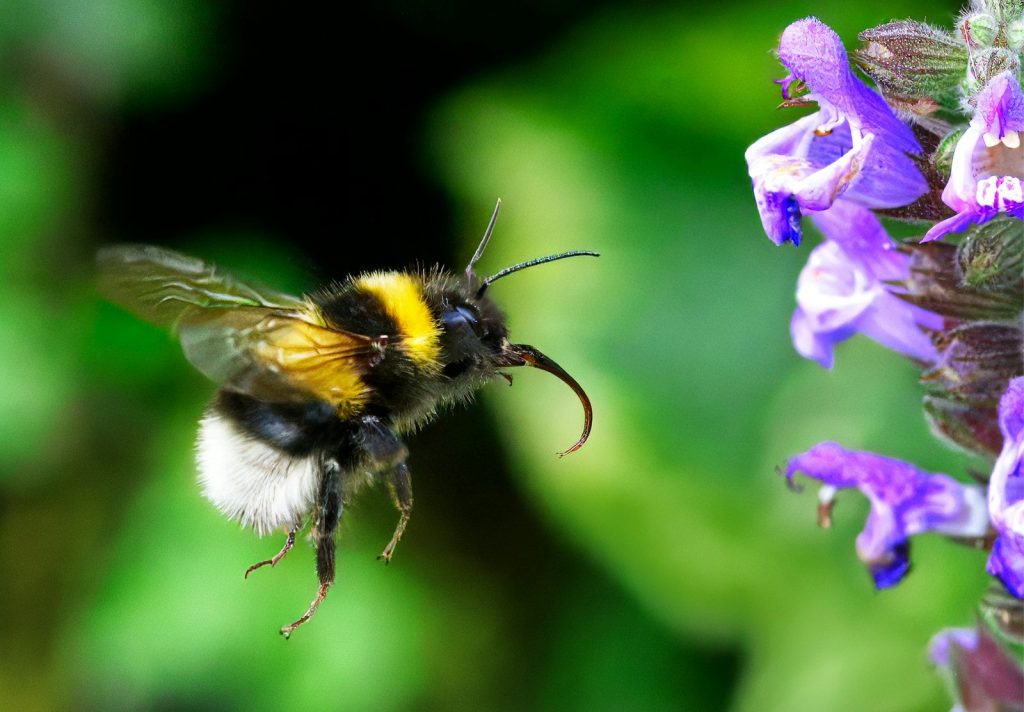
The experiments used Bombus terrestris, commonly called the buff-tailed bumblebee. Researchers from the Universities of Oulu, Helsinki, and Turku designed the work to test whether insects could generate a new solution without being directly taught the required action sequence.
That distinction was central to the experiment. Bees have previously shown impressive learning abilities, but a task can look sophisticated if an animal has already practiced similar steps. The researchers therefore controlled the bees’ experience before presenting the final problem.
Blue Artificial Flower

Before facing the puzzle, bees learned that a blue artificial flower provided a sugar reward. This familiarized them with the goal without teaching them how to solve the later object-manipulation problem.
The researchers then moved the artificial flower to the ceiling of a transparent arena. The chamber was deliberately too restrictive for the bee simply to hover up and feed from it, transforming a previously accessible reward into something physically out of reach.
Movable Ball

A movable ball was placed on the floor beneath the inaccessible flower. To solve the problem, a bee needed to relocate the ball to the correct position, climb onto it, and use the extra height to reach the reward.
The researchers compared the challenge to the classic “box-and-banana” problem used in studies of vertebrate cognition. The crucial feature was not merely touching the object; the ball had to be repositioned so that it became useful for reaching a separate goal.
Untrained Bee Solution

The bees had never been trained to roll the ball under the flower and stand on it. Successful individuals generated that sequence after being confronted with the new arrangement, which is why the researchers described the behavior as spontaneous problem-solving.
This does not mean the bees entered the experiment with no relevant knowledge whatsoever. They already knew the flower predicted food and had experience with movable balls. What was new was combining those pieces of information into the specific solution required by the test.
Bumblebee Ball Movement

Successful bees increasingly moved the ball in a directed way rather than merely rolling it randomly around the enclosure. The solution required bringing the object into the useful position below the reward before climbing onto it.
That matters because random interaction followed by accidental success would provide weaker evidence of flexible problem-solving. The researchers therefore designed additional experiments to separate simple attraction, play, and moment-to-moment visual guidance from behavior organized around reaching the artificial flower.
Hidden Flower Test

One of the strongest controls made the problem harder by hiding the flower from view while the bee began moving the ball. The bee therefore could not continuously steer toward a visible blue target as it repositioned the object.
Even under these conditions, most tested bees moved the ball toward the side where the flower had been located. In one experiment, the paper reports that 23 of 30 bees moved the ball into the relevant target area.
Goal-Directed Behavior

The hidden-target results were important because they weakened an obvious alternative explanation: perhaps bees were simply following the visible flower while pushing an object. Instead, successful bees could begin acting when the reward itself was temporarily unavailable as a visual guide.
The authors interpreted the overall pattern as evidence of goal-directed action rather than a simple chain of reinforced movements. That is a strong conclusion about behavioral flexibility, but it does not establish human-style planning, self-awareness, or conscious reasoning.
Bumblebee Intelligence

The study adds to earlier work showing that bumblebees can learn socially, manipulate objects, and spread learned puzzle-solving techniques through groups. A 2023 PLOS Biology study, for example, demonstrated socially transmitted alternative solutions to puzzle-box feeders.
The 2026 experiment goes further by testing a novel solution without direct training in that solution. Its broader lesson is not that bees think like people, but that surprisingly flexible problem-solving can emerge from nervous systems far smaller than those of vertebrates.